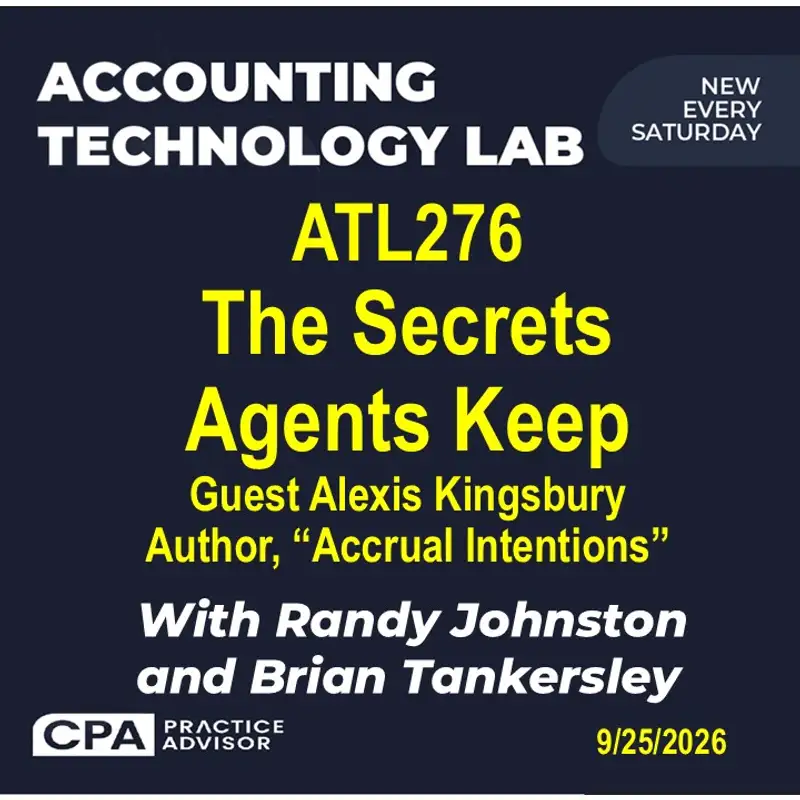
ATL276: The Secrets Agents Keep (Guest: Alexis Kingsbury, author "Accrual Intentions")
Download MP3In ATL276, Randy Johnston and Brian Tankersley sit down with Alexis Kingsbury, author of Accrual Intentions, to unpack what he learned from building a deliberately extreme experiment: an accountancy practice staffed by eleven AI agents with their own roles, personalities, and responsibilities. Kingsbury explains that the project began as part parody and part management-science experiment, but quickly became a practical test of delegation, workflow design, controls, and human judgment.
The central lesson is not that AI is either brilliant or useless. It is that AI can perform impressively on difficult tasks and still make simple, checkable mistakes. Kingsbury argues that firms should separate probabilistic AI work from deterministic processes, document workflows, insert stage gates, and decide explicitly where human review belongs. He warns leaders not to confuse delegating the work with delegating the thinking.
The discussion also covers token economics, local models, model portability, and the risk of locking organizational knowledge inside one AI vendor's project environment. Kingsbury recommends keeping core context, processes, and organizational knowledge in systems the firm controls, then connecting AI tools to that context. His closing advice: do not wait for perfect AI, and do not attempt a giant transformation. Pick a painful, valuable problem, solve it deeply, learn, and expand.
The central lesson is not that AI is either brilliant or useless. It is that AI can perform impressively on difficult tasks and still make simple, checkable mistakes. Kingsbury argues that firms should separate probabilistic AI work from deterministic processes, document workflows, insert stage gates, and decide explicitly where human review belongs. He warns leaders not to confuse delegating the work with delegating the thinking.
The discussion also covers token economics, local models, model portability, and the risk of locking organizational knowledge inside one AI vendor's project environment. Kingsbury recommends keeping core context, processes, and organizational knowledge in systems the firm controls, then connecting AI tools to that context. His closing advice: do not wait for perfect AI, and do not attempt a giant transformation. Pick a painful, valuable problem, solve it deeply, learn, and expand.
Key Takeaways
AI can be brilliant and stupid within the same workflow. Kingsbury describes Claude completing sophisticated work correctly and then altering an API-provided link enough to break it.
- Delegate execution carefully; do not accidentally delegate judgment. If AI takes over production, humans need to make the thinking, objectives, assumptions, and review gates more explicit.
- Deterministic controls matter. Where possible, use AI to create repeatable calculations, scripts, tests, templates, checklists, and processes.
- Review capacity has to scale with AI production capacity. Eleven virtual workers can generate an enormous volume of output, and that output still requires testing, prioritization, and accountable review.
- Your organizational knowledge should not belong to your AI vendor. Portability matters when prices, models, jurisdictions, or vendor strategies change.
- Token efficiency can become an economic issue quickly. AI consumption may require active optimization as usage scales.
- Waiting for “perfect AI” is not a strategy. Context, processes, guardrails, and review will remain necessary.
- Avoid the giant AI transformation project. Start with one sufficiently painful or valuable business problem, solve it well, and expand.
Short Promotional Copy
One-Sentence Promo
What happens when you give eleven AI agents jobs, personalities, responsibilities—and enough autonomy to expose everything that can go brilliantly right and spectacularly wrong?
Three-Sentence Promo
Alexis Kingsbury built an accountancy practice staffed by eleven AI agents and turned the experiment into Accrual Intentions. In ATL276, he joins Randy Johnston and Brian Tankersley to discuss what the experiment revealed about AI errors, delegation, controls, token economics, organizational knowledge, and human judgment. The big lesson: AI can dramatically expand what a firm can do, but only if governance and review expand with it.
Promotional Paragraph
Your AI agent just completed the sophisticated analysis, updated the documentation, called the right tools—and then broke the link it was supposed to give you.
That kind of contradiction is at the center of ATL276: The Secrets Agents Keep. Alexis Kingsbury joins Randy Johnston and Brian Tankersley to explain what he learned building the AI-staffed accounting experiment behind Accrual Intentions. The conversation moves beyond “AI good” versus “AI bad” and gets into the management problem: how do you provide context, separate thinking from doing, design deterministic controls, scale review, manage token costs, and keep your intellectual property portable instead of trapping it inside one AI provider?
That kind of contradiction is at the center of ATL276: The Secrets Agents Keep. Alexis Kingsbury joins Randy Johnston and Brian Tankersley to explain what he learned building the AI-staffed accounting experiment behind Accrual Intentions. The conversation moves beyond “AI good” versus “AI bad” and gets into the management problem: how do you provide context, separate thinking from doing, design deterministic controls, scale review, manage token costs, and keep your intellectual property portable instead of trapping it inside one AI provider?
Timestamped Pull Quotes
TimeSpeakerPull QuotePromotional Angle
05:03 | Alexis Kingsbury | “It'll just be easier if I do it myself.” | AI vs. delegation
12:40 | Alexis Kingsbury | “If you want a really good decision made, you don't want two people who think the same.” | Diversity of perspective
26:08 | Alexis Kingsbury | “There's value, but also risk… maximize value and mitigate the risk.” | Governance
34:28 | Alexis Kingsbury | “If you can get rid of the things that we don't enjoy… you get more time on the things that do add value.” | Human value
38:33 | Alexis Kingsbury | “If you are delegating the doing, you have to pull out the thinking and do the thinking up front.” | Management
47:03 | Alexis Kingsbury | “I've been able to improve token efficiency by 4,000x.” | AI economics
50:48 | Alexis Kingsbury | “One other big mistake I would suggest people avoid is giving the keys away to big AI firms.” | Vendor lock-in
53:15 | Alexis Kingsbury | “The technology is already good enough. It's just that you need all the guardrails and the context.” | Implementation
53:15 | Alexis Kingsbury | “Pick something in your business that is either incredibly frustrating and painful… or is a current missed opportunity for value.” | Where to start
05:03 | Alexis Kingsbury | “It'll just be easier if I do it myself.” | AI vs. delegation
12:40 | Alexis Kingsbury | “If you want a really good decision made, you don't want two people who think the same.” | Diversity of perspective
26:08 | Alexis Kingsbury | “There's value, but also risk… maximize value and mitigate the risk.” | Governance
34:28 | Alexis Kingsbury | “If you can get rid of the things that we don't enjoy… you get more time on the things that do add value.” | Human value
38:33 | Alexis Kingsbury | “If you are delegating the doing, you have to pull out the thinking and do the thinking up front.” | Management
47:03 | Alexis Kingsbury | “I've been able to improve token efficiency by 4,000x.” | AI economics
50:48 | Alexis Kingsbury | “One other big mistake I would suggest people avoid is giving the keys away to big AI firms.” | Vendor lock-in
53:15 | Alexis Kingsbury | “The technology is already good enough. It's just that you need all the guardrails and the context.” | Implementation
53:15 | Alexis Kingsbury | “Pick something in your business that is either incredibly frustrating and painful… or is a current missed opportunity for value.” | Where to start
Production note: Timestamps are based on the supplied transcript/SRT. Recheck them against the final edited episode before cutting promotional video.
Best Short-Video Pulls
The brilliant AI that breaks the easy thing — approximately 22:55–26:40
Discussion of deterministic versus probabilistic work, culminating in Alexis's story about AI completing difficult work and then altering a valid link.
Discussion of deterministic versus probabilistic work, culminating in Alexis's story about AI completing difficult work and then altering a valid link.
Delegate the doing, not the thinking — approximately 38:30–45:00
Alexis explains why removing the manual production step means leaders must intentionally preserve the thinking step.
Alexis explains why removing the manual production step means leaders must intentionally preserve the thinking step.
Tokens, local AI, and vendor economics — approximately 47:00–52:30
Discussion of AI subsidies, token efficiency, local models, and changing provider economics.
Discussion of AI subsidies, token efficiency, local models, and changing provider economics.
Don't give away the keys — approximately 50:45–53:10
Governance discussion about keeping organizational context outside proprietary AI workspaces and making it accessible through tools such as MCP.
Governance discussion about keeping organizational context outside proprietary AI workspaces and making it accessible through tools such as MCP.
How accounting firms should start — approximately 53:15–56:30
Don't wait for perfect AI, don't start with an enterprise-wide transformation, and don't waste time on trivial experiments. Pick a valuable problem.
Don't wait for perfect AI, don't start with an enterprise-wide transformation, and don't waste time on trivial experiments. Pick a valuable problem.
Suggested Show Notes
- Why Alexis created an accountancy practice staffed by eleven AI agents.
- Why the experiment began as both parody and serious management research.
- Custom GPTs and the early evolution of the virtual accounting team.
- Giving agents different roles, personalities, backgrounds, and perspectives.
- Why multiple viewpoints can improve AI-assisted decision-making.
- Moving from Custom GPTs to Claude Code, Claude Cowork, Codex, and agentic workflows.
- Why LLMs sometimes excel at complicated work but fail at simple tasks.
- Probabilistic AI versus deterministic calculations and processes.
- Using AI to build conventional software, scripts, templates, and controls.
- Why “I checked it” is not the same thing as having a testing methodology.
- The danger of delegating thinking along with execution.
- How AI changes management and supervisory review.
- Jevons' paradox, Parkinson's law, and what happens when automation lowers the cost of work.
- Why human judgment, context, prioritization, and care may become more valuable.
- Token economics and how dramatically AI efficiency can vary.
- Local models and private/on-device workflows.
- Why firms should retain control of organizational knowledge.
- Model portability and vendor lock-in.
- MCP as a way to connect models to context the organization controls.
- Why “wait until AI gets better” is poor implementation strategy.
- Why a giant, waterfall-style AI transformation can fail.
- Starting with an important, painful business problem rather than a trivial AI experiment.
Creators and Guests

Host
Brian F. Tankersley
Nationally recognized speaker (K2 Enterprises, 48 states in US + Canada) podcaster & author on accounting tech. I’m also a beekeeper, a husband, and a dad.

Host
Randy Johnston
Randy Johnston is a nationally recognized educator, consultant, and writer with over 40 years experience in Strategic Technology Planning, Systems and Network Integration, Accounting Software Selection, Business Development and Management, Disaster Recovery and Contingency Planning, and Process Engineering.