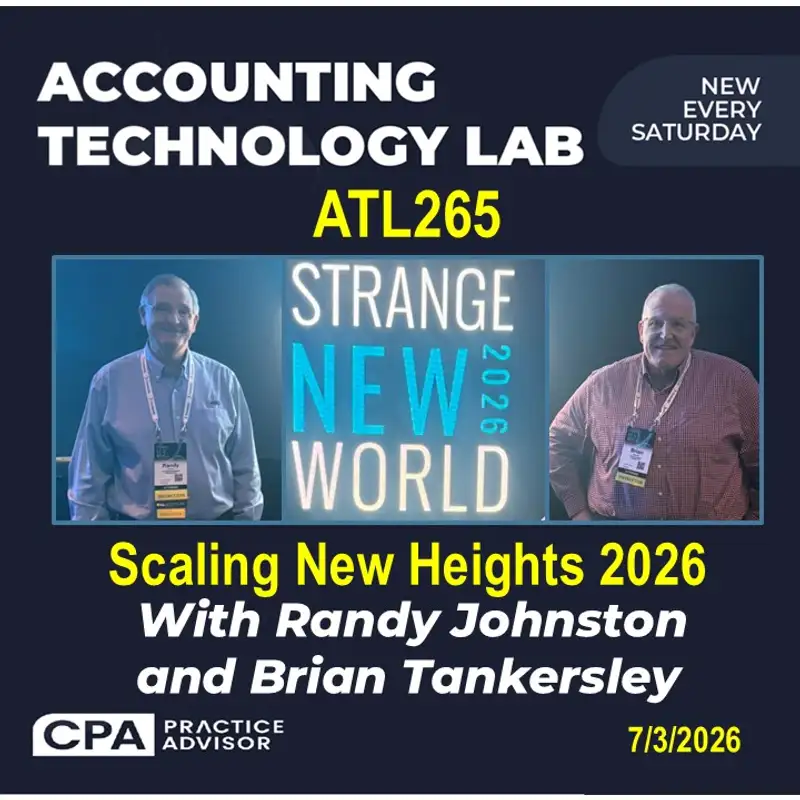
ATL265 - Scaling New Heights 2026- "Strange New World"
Download MP3Brian F. Tankersley, CPA.CITP, CGMA: Welcome
to the Accounting Technology
Lab, brought to you by CPA
Practice Advisor, with your host
Randy Johnston and Brian
Tankersley.
Randy Johnston: Welcome, the
Accounting Technology Lab. We're
coming to you live from Orlando
in the Marriott World Center,
where we're attending Scaling
New Heights 2026 Now it turns
out Brian and I are fortunate
enough that we've produced
sessions here, but just wanted
to give you a sense of what's
going on here, and as you try to
evaluate which show or shows
might be appropriate for you,
you know, this year's show
actually had quite a little bit
of attraction, but it was called
Strange New world, and you know
there's just a lot of things
that are strange with AI, but
what wasn't strange is
attendance was solid, about 2000
attendees here, and by my count,
133 exhibitors. I had the good
fortune to actually do a walking
tour of all of the new
AI-powered general ledgers,
which we've covered in other
accounting technology labs. I'm
sure there's going to be more
that we'll talk about in the
future, but just to set this up,
the Sunday sessions, the
orientations for first-time
attendees, I actually decided to
attend for a change, and it was
healthy because I got to hear
what newbies were being told,
and I don't have a good count on
the first time attendees, but I
would say it was probably 100 to
150 and it might have been more
than that, and then the practice
advancement session, which Joe
has taught frequently on Sunday
mornings I had not sat in one on
a while, and he did a nice job
talking about AI, and Joe
basically started the 40,000
foot overview of AI, and then
drilled down to a 30,000 foot
overview, and then down to
20,000 and you've heard me do
that. In fact, we've both done
that, talking about workflow
through the years, but Joe's
points were that, you know,
here's the big picture on AI
with all of the Chat GPTs and so
forth, but the landscape has
really combined has evolved into
a combination of the large
language models, the machine
learning, and so forth, and that
the 20,000 foot view says that
you can actually use AI to
provide more advisory services,
I think that's probably true, by
the way, and then at the 10,000
foot view, actually having AI as
a growth engine, and then what
he would call on the ground,
where there were actual live
steps, overall a nice setup for
the people that were there, and
that is a lot of the members,
and a lot of the newbies got to
hear all of that.
Brian F. Tankersley, CPA.CITP, CGMA: Unfortunately,
instead of being in fabulous
Orlando, I had the privilege of
spending the day in the Miami
airport, courtesy my friends in
American Airlines, but the good
news is they had an Amex lounge,
so you know, I noshed and
watched World Cup, and just had
a good time, but unfortunately
he only had the main man here.
Randy Johnston: Yeah, so on that
point, then I attended a couple
of sessions. I wanted to see
what Mara Negarovsky said about
bigger data, and that was a nice
session. So again, we know that
to make AI work properly, you
have to get your data clean, and
we've talked about that, and
we've seen that in other events.
Brian F. Tankersley, CPA.CITP, CGMA: I
like his operation, he just Nuba
Networks and Negroski
Consulting, I mean, it's he, for
so many years, has solved so
many pain points in CAS that
nobody else did.
Randy Johnston: Yeah, and when
you look at that whole
Mendelssohn operation, you know
he's just trying to do a lot of
the right things, but you know,
like we learned when we did the
black ore release work in New
York, everybody to a person was
talking about cleaning up data
consistently here so far, you
know, cleaning up data is still
a big deal, and it was clear
Mario was on that same path.
Brian F. Tankersley, CPA.CITP, CGMA: Well,
you can't make filet mignon at a
hamburger. I mean, it's, you
know, and if you're gonna, if
you're gonna make filets, you
gotta have good cuts.
Randy Johnston: Yeah, that is
absolutely true. So then I was
fortunate enough to see Christy
Monahan do a standard operating
procedure written with AI
sessions. She again did a nice
job, and it kind of set the tone
for, you know, the way I was
thinking about a lot of the
sessions. Usually at Scaling New
Heights, the sessions tend to be
rather short and practical, and
all of them are recorded so
members can see all of the
sessions, so unlike us, where we
maybe just get to see a few and
present a few, that's a little
bit different, but it was such a
pleasure then to do Tech Update
here, you know, the crowd here,
we've got a long-term
relationship with, and we just
had fun doing Tech Update, and
you've seen me do Tech Eight
update for fun, you know, a few
times. Times this year, but
there's a lot of content that is
the hardware needs and the AI,
and again, just a good overview,
but it really, I think, just
resonated well with the crowd
this time. So that got us over
then to the main stage opening
events, so that usually happens
for Scaling New Heights on
Sunday night, and the way Joe
tries to manage the show,
there's usually main stage
events to kind of end the day,
start the day, so book in the
day, if you will, and he had
brought in a well known as the
world leading tech magician,
Akilan Leiser, out of the UK,
and his wife, I think her name
was Elizabeth, but you know,
bottom line was he did some
wonderful tricks for using iPads
and robots, and so forth. And
what I thought was fascinating
about that, and you didn't get
this experience, they said they
would not open the doors once
they started the main stage for
at least 10 minutes until the
first sequence was done.
Brian F. Tankersley, CPA.CITP, CGMA: That
sounds like something you do on
Broadway when you have, you
know, like some monolog or
something,
Randy Johnston: and it was
absolutely didn't need the
interruption, so and he did a
really nice job, but you know,
being able to have an iPad where
you know it has a picture of a
tennis ball and you pull the
tennis ball out, as an example,
or a spinning wheel, and then
all of a sudden he's got a
medallion in his hand, or one of
my favorites was the
butterflies, where the
butterflies started coming out,
and all of a sudden there's
butterflies flying everywhere,
or the reverse, it had a red
scarf, and it got sucked into
one of the iPads, that type of
thing, and they used a robot
dog. Well,
Brian F. Tankersley, CPA.CITP, CGMA: some
iPads do suck.
Randy Johnston: Yeah, well, that
does happen, but this one was
hard to picture where it went,
but the robot dog, where they
actually did card tricks, was
also fascinating, because the
robot dog picked the card that
was identified by an audience
member, written on by an
audience member. You know how
magicians work, it's kind of
deal, but that was kind of the
idea, and it turns out that Joe
opened up with just a few
general comments for the
conference, and then did an
interview with Sasha Orloff of
Puzzle, and Sasha's company,
Puzzle, now has about 10,000
users, which is good, and they
just chatted about how AI can
serve the profession, and it
should not be the other way
around, was part of their
conclusions on that, and also an
interesting observation. The
question about AI replacing
accountants, no, but 50% of all
token spend right now, they
said, was for software engineers
and the salaries were the
highest they'd ever been, so
not.
Brian F. Tankersley, CPA.CITP, CGMA: And
I have to say this about the
token spend, I think that's an
important thing when you see the
stats, because when you look at
the stats on subscriptions,
people that are buying this
through subscriptions, Claude is
only like five or 6% but
everybody that's developing, or
most of the people developing
software, either have a $200 a
month cloud pro plus titanium, I
don't know what it's called, but
some superlative plan that has a
bunch of, as a bunch of tokens
available, but most many people
are just buying tokens, kind of
like you buy gas for your car
and then use them, so they,
they're not. It's harder to
measure who's using how many
tokens and what the real user
count is.
Randy Johnston: Yeah, they're
very difficult to figure out.
So, you know, then at that
point, you know, a little bit of
a history walk with Joe, but
this is the 18th scaling new
heights, and he started the
first one at the Crowne Plaza in
Atlanta with 250 people, for
this to be 2000 people this time
around, you know that's quite an
accomplishment. But next up was
David Barrett, you know, David
founded Expensify, and actually
something I didn't know, and I
can't verify, in fact, but I am
going to repeat it here, David
Barrett had coded Expensify with
blockchain the year before
Bitcoin's blockchain came out,
Brian F. Tankersley, CPA.CITP, CGMA: really,
Randy Johnston: and I, that's
pretty verifiable, and it's like
that's pretty interesting, you
know. I knew he was, you know,
hardcore coder, but that was
also interesting, and then he
went on to explain how AI should
work and what the experience
should be like, and I hadn't
really thought about the AI
enablement in the expense
tracking products that he's
built, but he was very
thoughtful about how he deployed
the AI, and so that was worth
seeing, and then really the star
of the show was, you know, Dr.
Daniel Susskind. We've
recommended the book before. His
book originally was out about
2015 and I reread it
anticipating his presentation.
Brian F. Tankersley, CPA.CITP, CGMA: What
the professions.. what's it
called.. the, you know, the next
generation of professions, or
something like that,
Randy Johnston: and that. Book,
as it turns out, he's actually
got a new one coming in the
fall, which is about, you know,
what the, what you should do
with children, so forth, but the
key here is that he quoted a
fair bit of statistics and tried
to show the arc of what had
happened with agricultural and
manufacturing, and so forth,
and, you know, also the impact
on several different areas, so
he basically said, "Look, I'm
going to talk about six areas:
I'm going to talk about blue
collar, I'm going to talk about
white collar, then I'm going to
talk about AI, and then I'm
going to return to white collar,
and then I'm going to talk a bit
about education, and then
artificial general intelligence,
and it was a nice arc. He moved
fairly quickly. There were a lot
of facts that he covered, things
that you and I have talked about
in the past, and you know,
including things like Deep Blue,
the chess piece, and you know,
the Garry Kasparov defeat. And
then
Brian F. Tankersley, CPA.CITP, CGMA: 30
years ago, isn't it? Now, I
mean, it's
Randy Johnston: 1997 which is
hard to believe, and then also
the Jeopardy situation with
Watson, which he cited, and you
know, his father was actually
early on in AI and created the
first AI-based law system, so
father-son, or you know, both
heavy into this stuff, but the
disruption,
Brian F. Tankersley, CPA.CITP, CGMA: but
that's a fun Thanksgiving, isn't
Randy Johnston: it? Yeah, you
know, sometimes you can
Brian F. Tankersley, CPA.CITP, CGMA: get,
Randy Johnston: how do you say,
blah, yeah, kind of like
Brian F. Tankersley, CPA.CITP, CGMA: halbla
hubbla, hey, huh, blah blah
blah, you know,
Randy Johnston: kind of like
Charlie Brown and Lizzie,
exactly. but it was fascinating
because he cited an Economist
article from October 17 of 2015
which I had put in Tech Update
that year, and so it was a
little bit like Old Home Week,
but many of the statistics I
knew from his book, but also had
incorporated in our
presentations through the years,
so
Brian F. Tankersley, CPA.CITP, CGMA: future
of the professions, that's the
title,
Randy Johnston: future the
profession,
Brian F. Tankersley, CPA.CITP, CGMA: the
title, it's great book,
Randy Johnston: it is, so as it
turns out, in 2017 McKinsey
published a piece saying that 5%
of jobs can be automated, and he
breaks down tasks, and that's
really the key learning here.
His theory is that even if
you've got a profession, many of
the jobs are tasks that can be
automated, and so if you can
automate the tasks, that gets
you some leverage. But he went
on to say it's the human
interaction and the creativity
that the machines have not been
able to duplicate at this point,
and then he went on to talk
about the Khan Academy and the
Mika, a piece that had been
built, and honestly, for this on
this recording, the book that
I'm in the middle of is AI for
Good Josh Tarantiel book, and
it's a great book, but I don't
recommend most books until I've
finished them. There's three
sections, and the Khan Academy
was the first, and it's like,
oh, that's very good, and right
now we're in Cleveland Clinic
territory, but in the big
picture of things, he goes on to
drive that education is the
response to AI, if you educate
and do the change management,
educate, but several attendees
that I respect here, and several
innovators are saying that
they're using as much as 1/3 of
their time on education right
now. So, if you think about it,
and we'll just talk 40 hour
weeks, you know, if you're
spending 1012, hours on AI every
week, most of us don't have that
type of,
Brian F. Tankersley, CPA.CITP, CGMA: I'm
spending about 30, yes, because
it's it's one of those things
that is, you know, for what we
do, which is training and
development and consulting and
workflow tracking and all that,
it's just, it's you can either
run as fast as you can now or
you can take early retirement,
you know, and so we're, you
know, tying those shoes,
Randy Johnston: yeah. So it
turns out, then closing up with
artificial general intelligence,
and you know, just end to end a
well thought out presentation,
but we, he suggested that you
take AGI a lot more seriously,
but it's going to take a
combination of business leaders
and politicians and parents, and
it's a profound change, but that
I'll say caution about taking
that seriously is a big deal.
So, in any case, then from
there, you know, the conference
started unfolding, and you know,
again, every time there was a
main stage presentation, usually
the magician would come back out
and do some sort of routine at
the beginning of their end, so
Keelan and his wife, as the
assistant, did a number of
those, and that really was true
on. Each one now, because of
time constraints, we probably
will talk a bit more about
vendor sessions and other
observations in another
accounting technology lab, but
it is clear that there's much
going on, and the level of
scaling new heights is quite
different this year than it has
been in prior years,
Brian F. Tankersley, CPA.CITP, CGMA: but
we still got, I still got to
have my audience with the Pope
of pricing, Ron Baker, you know,
and it's, I got to see, I got to
see, you know, Joe and Caleb,
and got to meet a lot of new
people here. It's always fun to
go here, because they're. it's.
it's. I don't know, it's some
very nice crowd,
Randy Johnston: yeah, that good
people doing good things for a
lot of businesses, and let's
face it, Microsoft was a anchor
sponsor, and realistically, your
ability, my ability to deliver
AI sessions here was probably
enhanced because of that, I
think between us we've got five
AI sessions in addition to tech
updates, and I will
Brian F. Tankersley, CPA.CITP, CGMA: say
this: we're not the only AI
sessions here, and you know,
Microsoft, though I will say
this, I think people don't
under, you know, people getting
all excited about Claude, and
they got really excited about
ChatGPT, but what I think they
don't get is that Microsoft is
taking the compliance very
seriously, and I think it's, I
think they're the only ones that
I'm seeing, especially in light
of the logging that they started
to do with the new Claude,
that's that even enterprises
could opt out of. I think that,
you know, the Claude five that
they pulled Fable, I guess it
is. I'm, I think Microsoft has
got the right approach to use of
AI inside of companies, because
they, you know, they're just,
they're dotting the i's and
crossing the t's, and as a
profession, where when you don't
dot the i's and cross the t's,
bad things happen. I, you know,
it's a very, I think you need to
pay attention to that,
Randy Johnston: and you know,
along that line, this is a big
year of AI governance. Last year
we said you always start with a
policy, but now you've got only
got to try to restrict things
with governance, and I brand
reviewing a new AI policy that
we've created, but it's got 26
different governance-related
issues on AI platforms,
including all of the bigs,
Walters, Kluger, and Thomson
Reuters, and so forth, but even
smalls like Kanopy interfacing
with files, and we talk about
the reasons that happens, but as
I started digging into what you
have to think about as you use
different platforms, there's way
more there than I thought, and
so the simplistic AI policy that
I'd recommended in the past, it
just didn't stack up to today's
needs, and you're going to hear
us talking more and more about
the governance and coding and
all these things that you can do
with AI,
Brian F. Tankersley, CPA.CITP, CGMA: and
I've got a session that I'm
doing, actually tomorrow, as
we're recording this. It's
Monday night, I'm going to
record the.. I'm going to do the
session tomorrow afternoon, but
we're going to talk about the
governance issues in pretty good
detail, and one of the things
that we're going to talk about
are privacy policies in EULAs,
because EULA, of course, is an
end user license agreement. One
of the things that I think that
people don't realize is that in
many of these EULAs they
incorporate by reference the sub
processors' user license
agreements, and sometimes they
don't even tell you who that is,
they just say we have sub
processors, and by the way, they
have their own user license
agreements, and you're stuck
with theirs, and it's, it, you
know, this figuring out who's
really who really has access to
your data and who's using the
data for training, you know, I,
I've done a bunch of reading
lately about the impact on HIPAA
and FERP, and a lot, and you
know, all the PHI and PII rules,
and it's very unclear what's
permissible, but it's also clear
that there there's a lot of
stuff going on that, at a
minimum, is highly frowned upon.
Yes, of using data for things
that are not good,
Randy Johnston: and vendors at
this conference, Scaling New
Heights, and the prior
conference, AICPA engage, who
wanted us to look at their
products, you know. Normally,
the first thing I do is go look
at the privacy policy, and the
last one that I looked at today
said we used sub processors,
didn't name them, didn't say
anything, didn't know reference,
and it was like, oh, good, but
you know, let's take a couple of
other names, I am
Brian F. Tankersley, CPA.CITP, CGMA: Oz,
that's who the sub processor is.
Yeah, the guy behind the
curtain,
Randy Johnston: behind the
curtain, for sure. But you know,
I want to call it two other
things, which we're not really
trying to talk about in this
podcast, but just of note, the
Meta Ray band glasses. There was
a winner from Main Stage today,
they got a pair of those, and
you know, if you look at the
price. Privacy on meta ray
bands, it's not pretty, and
Brian F. Tankersley, CPA.CITP, CGMA: you
met meta and privacy are two
words that should not be in the
same sentence
Randy Johnston: most of the
time, not. And then the other
big announcement with the
worldwide developer conference
from Apple was the alliance
between Apple and Google, which
will unfold as the year goes on,
so when we look at the new
generation AI computers,
Google's the Google book, which
is not a Chromebook, it's an AI
machine, and Nvidia's machine.
I'm watching this processing
power at the edge, and you know
where the big players are
playing, and we'll try to get
some clarity for you, that for
you on those topics in future
accounting technology labs, but
I gotta tell you, it's not clear
to me right now, so I'm not sure
I could explain it to you.
Brian F. Tankersley, CPA.CITP, CGMA: My
gut is that accounting is, we
are so reliant on having stable
systems that this new crazy
stuff at the edge that's
experimental and everything, we
have two or three years before
it really starts affecting us,
and the other thing is that,
with from a regulatory
perspective, because we have all
this super private data, we have
to be grown-ups all the time,
and that's the hard thing, you
know, because the sales people,
a lot of them can do all kinds
of crazy things with data, and
they can put leads in there, and
everything else, because, you
know, when somebody puts their
data in a form and they hit
send, you can do just about
anything you want with it, but
it's a, you know, the thing that
you've got to understand that
sets the profession apart from,
you know, from the sales people
and from the marketers and all
the folks like that. The
marketers and sales people
aren't doing anything unethical,
but they just don't have the
legal requirements that you and
I do with PII, and that's why I
think Microsoft is has, I think
that's why I think Copilot
really has some legs, even
though there have been some
criticisms of the platform. I am
quite excited that it's starting
to include some of the cloud
models, so you can pick your
model and yet still be
indemnified, and all that, which
I think is glorious, and one
other piece that Sasha, CEO
Puzzle, said, which is also
landing pretty well with me,
probabilistic versus
deterministic, and if you think
about our legacy accounting
software products, you put in a
number, you got the same answer
all the time,
Randy Johnston: and with the
statistical models on AI,
they're not quite as predictable
on the outcome, and the
analogies that he used in
several different situations did
make sense.
Brian F. Tankersley, CPA.CITP, CGMA: Yeah,
one of them was one of them was,
do you want vending machine, you
want the accuracy of vending
machines or the accuracy of slot
machines? You know, do you want
something where every time you
put a quarter in you get a, you
get a bag of chips, or do you
want something where you put a
quarter in, and maybe you do,
and maybe you don't. It's a..
it's.. and that's.. I think
that's one of the hardest things
for a lot of accountants to
understand about AI, is that it
is very ish, you know. It's not
some.. you know, it's kind of
like when you know you could
have a huge.. you could have a
huge English class that had 800
people in a massive chemistry
lecture hall, and you could give
them all the exact same
education, the exact same text,
and the exact same assignments,
and just like with AI, you would
get 800 different answers, and
some of them would be out here
on the bell curve as A's, and
some of them will be up here as
C's, and some will be down here
as F's.
Randy Johnston: Yeah, it's we,
as you said multiple times, we
live in interesting times.
Brian F. Tankersley, CPA.CITP, CGMA: Yes,
Randy Johnston: so we'll be back
with some more interesting times
for you in the Accounting
Technology Lab. We appreciate
you listening in today, and
we'll talk to you again very
soon today.
Brian F. Tankersley, CPA.CITP, CGMA: Thank
you for sharing your time with
us. We'll be back next Saturday
with a new episode of the
Technology Lab from CPA Practice
Advisor. Have a great week.
Creators and Guests