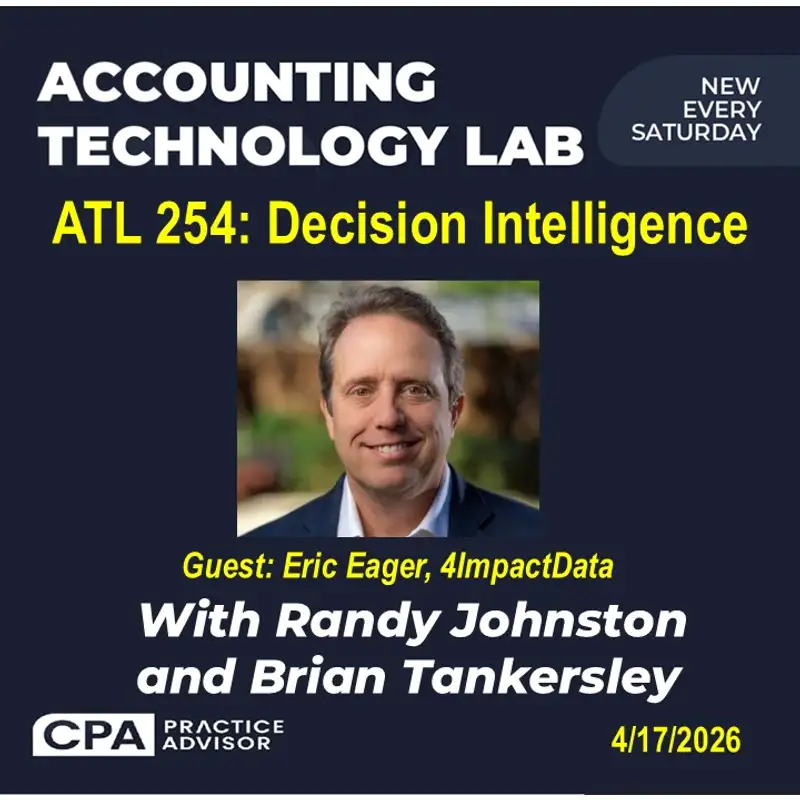
ATL254: Decision Intelligence with Eric Eager
Download MP3Brian F. Tankersley, CPA.CITP, CGMA: Ryan,
welcome to the accounting
Technology Lab sponsored by CPA
practice advisor, with your
hosts, Randy Johnston and Brian
Tankersley, hi everybody. It's
Brian, working hard at the lab
today, but I thought I would let
you know that do have a quick
announcement? We have a
giveaway. We're going to be
giving away one Rico, scan, snap
IX, 2500 receipt edition. We're
going to draw. We're going to
make the drawing right after
April 30. No purchase required.
Suggested Retail value, $599
this is a one has one touch
simplicity, and our friends at
Rico graciously provided it to
us with automatic invoice OCR,
detachable receipt guide for
small and curl documents and
lightning fast, 45 page a
minute, duplex scanning. It
transforms paperwork into clean,
searchable digital data in
seconds. If you want to
register, it's CPA te.ch/scan
snap. The rules are at CPA
te.ch/rules and the privacy
policy is at CPA, te.ch,
forward, slash, scanner, dash,
privacy. And for those of you
attending the video, attending
the video version of this, I've
actually put on the screen now a
QR code that you can capture and
use to register for the for the
again, for the scanner. Giveaway
again. We're giving one away.
We're going to give it away
again right after April 30 and
again. You must, you must be an
accounting professional when all
the rules again are at CPA te
CH, CPA te.ch/rules so anyway,
with that, thanks for joining
us, and here we are back in the
lab.
Randy Johnston: Welcome to the
accounting Technology Lab. I'm
your host, Randy Johnston, with
co host Brian Tankersley, and we
are so pleased to have a guest
today, Eric eager. Now, I've
known Eric for 20 plus years
from his old days at a
predecessor company which we'd
recommended to you, biznet, but
about seven or eight years ago,
Eric reached out to me and said,
You know, I've got a new idea.
And I listened to him, and I
said, you know, Eric, you could
be playing golf. And he said,
No, I want to make a difference.
I want to help small businesses
succeed, and I've got a great
idea to do it. It turns out, I
think he did, and over the last
years, he's been building a
platform called for impact data,
the number four impact data,
Eric, welcome to our podcast
today. Would you like to give a
little bit of introduction on
yourself now?
Eric Eager: Great, Ray, thank
you for having me on the show
again. I am a CPA, and I feel
like we been working on this
challenge of, how do we change
the odds for business owners,
and then at the same time, how
do we elevate the profession and
recognize the work and the
impact that we have on
businesses? And so we've been
working really hard on this. How
do we help the shift to
advisory? And I think that we
have broken the code, cracked
the code, as they say, and we'll
talk more about it, but, man, we
are super excited to tell people
more about it and help the
transformation in the
profession.
Randy Johnston: Very good. Well,
for our dedicated listeners, you
may recognize that Brian and I
have recorded a session on for
impact data in the past, but oh
my, it is so different.
Brian F. Tankersley, CPA.CITP, CGMA: So,
you know, Brian, it was like
four years
Randy Johnston: ago, so
different. So, as you may know,
has probably reviewed more small
accounting products than you
have ever seen in the past. And
just to give you a perspective
on that, you know, we go back to
the days of the peach trees. In
fact, I was actually drawn into
a recent interview from the
Privacy Forum, and I couldn't
believe that I heard an old
lotus, 123, name. I didn't
realize he had helped found the
Privacy Forum. But again, we're
lucky enough to have had the
long haul with the some of these
very well known products of the
past as well some of the new
products of today, so the
digits, which we've done
podcasts on, and others. So
we're really shifting from
transactional accounting and
financial reporting into
something that is quite
different. And you know, the
team at for impact data have
landed on the term decision
intelligence, but it really
probably evolved from a bit of,
I'll say, observation by Gartner
Group. So Eric, I might ask you
to take a moment and just help
our listeners understand what
decision intelligence is.
Eric Eager: Well, it's going to
be, you know, here's the thing
is that it is the next evolution
of AI, and it's not replacing
AI. It's kind of the things that
we've we've been working on. And
as you guys pointed out for the
last four or five years, and we
didn't realize we were building
it. But what decision
intelligence does is that it
takes the combination of AI,
data science, business
intelligence and humans
expertise, it literally gives
you the ability to codify the
experiences of others, but the
differences here is that what AI
is what they call probabilistic
and text driven. Decision
intelligence is deterministic.
It will literally tell you
statistically. Here are the best
actions to take, taking all
things considered, and it
provides you an audit trail of
how that decision was come to so
it is really this ability to
take from probabilities and what
you think to literally what
decisions are going to give you
the highest probability of
success.
Randy Johnston: And for those of
you who have attended a lot of
our k2 events. You might recall
that over a decade ago, it was
2015, and 16, we were presenting
heavily on data science, and for
those of you where I actually
did your on site tech
assessments, I frequently
recommended that you had a data
scientist in that window. Now, a
lot of this AI that we're
dealing with as you are,
probably also where it's been
around since the late 50s. 1958
is when AI started. But many
people think AI started when
chat GPT was released in
November of 22 you know, his
granddaughter from New York
says, grandpa, that not be the
plan. That is not the plan.
That's not how it happened. But
in about 2010 we started seeing
a lot of these pattern
recognition and pattern matching
and machine learning and this
evolution into the reporting
tools that Eric and his team
used because they took as their
basis Power BI and wanted to
have drillable dashboards in
some of the earliest models.
That was interesting, but it's
now a combination of for
decision intelligence, all of
these things, of AI and data
science and behavioral and so
forth. So you know, Eric, I know
you've been looking at the
Gartner content on this. What's
Gartner have to say
Eric Eager: on this? Well,
Gartner says that, literally, if
you haven't heard of decision
intelligence, you're going to
hear quite a bit about it in the
coming years. And here's what it
is, the reason being, and the
thing that I'm trying to help
elevate is that while you're
hearing all this AI decisions,
the challenge is that it is
incredibly powerful, but it's
changed. The answers are
changing. Every time you ask a
question, it is a black box. And
what's happening is that more
and more as we move into
advisory in these other pieces,
it is going to cause,
unbeknownst, what we call false
confidence and advisory, and
they are projecting it's going
to cause financial and
reputational loss simply from
the fact of human bias, ability
of critical thinking and aos AI
sycophancy, it is still as much
as they're trying it is going to
please you. And 2030 Yeah, I'm
sorry, go ahead.
Brian F. Tankersley, CPA.CITP, CGMA: So
effectively, we're going to be
lemmings running off a cliff.
Because AI said, Hey, wouldn't
it be a great idea if you ran
off a cliff Exactly?
Eric Eager: Now, here's the
thing, though, AI, if managed
correctly and you compliment it,
it will unleash capabilities
that all the positives and the
excitement, and why I'm excited
about it, and these models, by
2030 it will be five times more
trusted. It will be faster in
governing decisions than
ungoverned decisions. And this
is why you're going to hear
these things, because, and I'll
talk a little bit about, you
know, why is this happening?
Randy Johnston: Well, but you
know, on that point, Eric, I
think the good and bad we've
talked about that with past all
technology can be used for good
or bad. But the bad number that
we didn't quote for you is that
by 2027, 25% of the decisions
will actually have financial
impact in a negative way. That's
a big deal, because 2027 is a
lot closer than you might think
Eric Eager: well, and I'm glad
you pointed that, Alex, that
sometimes I forget we have audio
listeners and not video
listeners. So yeah, thank you
for pointing it out, because
that and I've heard and I've
talked to, you know, profession
and AI leaders throughout the
world, and they say that number
may be low, that it can be
significantly higher if we don't
watch it. So I'm glad you point
that out and in. So why is this
in? Important. Well, you know
what's happening is, AI, is the
world and velocity of business
is accelerating way before it's
happening so fast that we're all
having to react and do things
well. Ai, you know, the way that
we make decisions today is that
before you know, we have these
analysts that would bring
reports to us, and as leaders,
we would take all this
information and have to
prioritize and risk and see
what's short term and long term,
and then you had to make the
call, and then you go hand it
down to your operational team.
Well, what AI? And the
excitement about AI, it is
surfacing so many options now
that you're turbo charging your
analyst? Well, what that's doing
is that now it is accelerating
all these options to leaders,
and it still doesn't tell you.
It doesn't give you the well,
all these options for my
company, which one takes
precedence? What time do we need
to implement? What's the trade
offs, if we do this versus this,
I still have to make those
calls, and that's myself and my
advisor. Because we're always
going to have the need for
advisors. No matter what the
technology does, we're still
going to need that human
advisor, and it's going to cause
decision fatigue. And so all of
a sudden, we're going to make
the call. And now, if you add in
AI agents to that, the speed of
exit, the beauty of what Randy
said, the beauty of it is we can
execute with such speed and
precision. But the challenge is
that you may be heading towards
a brick wall, except now we're
just going to do it 100 miles an
hour.
Randy Johnston: Yeah. Yeah, so
the question is, bugger
windshield, huh?
Eric Eager: Well, we're going to
make sure that here's the thing,
and this is the missing piece. I
want to give people hope that
this unbridled power, I, like,
you know, like spider man, with
great power, comes right, great
responsibility. Here's the
thing, that there is some
excitement and that you add the
layer of decision intelligence.
This is why you see Gartner and
everybody. You add that as a
layer to complement your AI. And
it does is it continuously
monitors. It helps you see the
emerging risk. It sees the
opportunities. And now it's an
augmentation of decision
confidence. It helps the
advisors and leaders prioritize
actions, what timing, and it
doesn't replace it. Now turbo
charges the advisor and oh, by
the way, it raises the
confidence level of the
decisions, and now the agents
can execute. So this can really
have the impact that I think
we've all been wanting to help
businesses with. And we will, we
really do have a chance to
change the profession.
Brian F. Tankersley, CPA.CITP, CGMA: So
effectively, this is the human
in the loop, the advisor that is
serving as those Spartans at
Thermopylae that are preventing
the hordes of bad ideas from
coming to reality bingo.
Eric Eager: And this is where I
think the this we have always
been business advisors that the
CPA profession has always we've
been what I want to call
invisible advisors. And this is
our opportunity to really
showcase where we have been.
Always. A lot of people get in
the profession because we really
want to help businesses, but we
got so bogged down into in my
history, you know, I'm a tax
guy, I got so bogged down that
by the time I got everything
finished, I didn't have any time
left to really help people. And
now I really think this is
elevating. It's the grand
promotion for everybody. Now, a
lot of people listening are
probably going, I still don't
understand what's the difference
between AI and decision
intelligence. So there's a lot
of things. AI is reactive. It
only reacts when you ask it a
question, and it will answer
questions. It's really text
oriented. But here's the thing,
it's probabilistic. So what that
means is, every time you ask it
a question, you'll get a
different answer. But the
things, the most important thing
that everybody needs to listen
and I think everybody gets it
operates in a black box. You
don't know. So if you're growing
an advisory firm and you're
going AI first, the challenge
you've got is that you may have
10 advisors ask the same
question and get 10 different
answers and oh, by the way,
here's the other thing your
clients can punch in the same
queue and same prompt into AI is
your advisors, inner decision
intelligence, it is now
proactive. It's constantly
probing and seeing the emerging
risk. But it's what we call
deterministic. So what that
means is that, depending on the
same input, you will get the
same output, and it continuously
learns, we call this code. Five
wisdom. So it's continuously
learning, but that's that human
advisor in the loop. It
literally tracks, hey, what
worked, what didn't, and it
keeps the advisor in the loop
for a point of context. And last
but not least, it gives you a
complete audit trail. It's
transparent of how those
decisions and literally we can
get in, it literally creates
decision tokens. So at any point
in the you know, things go by,
you can see how the decisions
were made. This is why I think
the accounting profession will
be so excited about this
possibility, because it fits
within our audit ability and
tracing, but also increases
confidence of what advice we're
giving the client.
Randy Johnston: Yeah, in fact,
Eric, when you first showed this
to me and the audit trails and
how you could track how the AI
was making decisions in the
platform, and how it was showing
things over a longer period of
time and so on. It's like, this
is really smart, and, more
importantly, it is reproducible.
So you know, your whole codified
wisdom is, I've watched your
journey on this, Eric, over the
last few years, because it was
some years ago that you came up
with this business GPS idea and
use the cockpit in the aircraft
system, which, again, makes
great sense. If you've ever
flown an airplane in particular,
it makes all the difference in
the world and the way the GPS is
work. But this decision
intelligence engine has several
different tricks, as I would see
it to it, it's, can you explain
that to our listeners?
Eric Eager: Sure. So the
difference between, like I said,
the difference between AI and
decision intelligence is it is
continuously monitoring so it
has your financial operational
data, and what it does is it
looks for signals and trends.
And it's not just on one plane.
And literally looks across
multiple planes for signals, so
it can see things happening
months at a time, so it begins
to uncover these emerging risk
and opportunities. Because, just
to kind of backtrack a little
bit, even while we started doing
all this, is that we were
wondering we took on this
gigantic challenge of why
businesses are failing at 50%
you know, 50% are going to fail
in the first five years. We hear
this over and over again. So we,
I went to Randy and said, this
has got to change. How in this
world does this continue to
happen? Well, that sent off a
journey of why businesses were
failing. Well, they were
failing, you know. And I'm sure
that a lot of listeners can
think, well, it's cash flow. It
really came down to and I'm glad
everybody's sitting down or
driving your car. It was because
we don't know what we don't
know. And what happens is that
we have to see and the primary
reason is that business owners,
we see the risk too late, and we
make decisions after the fact,
and then we point on the wrong
things. So what decision,
intelligence, or this codified
wisdom, is to monitor where
you're at, see what the road
ahead looks like, and reroute
you to the destination so see
what signals are coming, see the
emerging risk. Have the GPS kind
of thing is recommend the best
routes to take. But here's the
magic, you always have an
advisor in the loop. You have an
advisor going, let me measure
these things and make a
recommendation. You know, work
with the business leader, but
now you got confidence of how
you came to those things. And
then you begin to track what
actions were executed. Because
the other thing Gartner pointed
out is that 80% of decisions
that are executed never get
measured. So you get this teams
you execute and you don't
measure it. So you have this
closed loop of working with your
advisor, measuring what you
know, basically dead,
documenting what actions were
taken in the system, and
continuously measure those
outcomes, and then you learn
what worked best, and then it
creates this closed loop, and
think about that at scale. So
now, as entrepreneurs and this,
you know, guardians, we all
don't have to make the same dumb
mistakes over and over again. I
am a I have a PhD in dumb things
to do in business, and so this
helps elevate everybody across
the board, and it continuously
gets smarter, and it
continuously helps us, guide us
and our clients of what's
working and What works best, if
that makes sense to everybody,
yeah.
Randy Johnston: So this whole
strategy of trying to help
business proactively decide, and
I was reflecting on your mention
of KPIs, because I've been a fan
of KPIs since Harvard introduced
those back in 1992 but the KPIs
were often in. Correctly
selected, not measured, not
really the right things. It took
me better part of 10 years to
get the right KPIs for my own
nmgi business, and now I'm
thinking about it, saying, I
wonder if I've still got the
right KPIs. But in effect, this
is not automatically, but it is
surfacing the right KPIs, the
right actions, and then
monitoring those after the fact,
which is all a pretty big deal.
So in effect, then you said,
scale. So can you explain how
this allows advisory to scale?
Eric Eager: Well, that's a great
question, because the other
thing too is, you guys, you
pointed it out. We've been after
this, solving this problem for
about, you know, going on about
five years now. Well, what we
discovered in this process and
journey, because we were just
dogmatic, we were going to fix
this problem, we were going to
solve this problem, how to help
our profession. What we realized
is that the the whole
profession, the reason that
we're struggling with moving to
advisory. It's what we call a
confidence gap. And it's really
and it makes sense, when you
look at it, is that you've got,
you know, we, most people,
realize this is 75% of the
partners in the profession right
now are retirement age. There is
going to be a massive brain
drain knowledge walking out the
door at the same time, you've
got this next generation of
people with advisors. Here's the
confidence gap problem. I'm a
young advisor, and I want to
start doing advisory Well, I've
got a major client, a major tax
or audit client, a lot of
revenue to the firm. I'm afraid
to make the wrong decision. I
don't know if I have the
confidence to make that call. At
the same time, the senior
partners are going, I man, we
can't risk this. And so you have
the partners that all the
knowledge is tight, and so
everything's going to go through
them. The younger staff are
going, I don't want to make the
call. So this, I'm going to get
this documented and all over the
place, so it creates this huge
gap of I can't move forward and
enter now, the bigger risk is
that now, all of a sudden, you
know, I don't have confidence. I
don't wanna do this. Here's the
bigger issue, is false
confidence. Now the younger
staff and everybody's relying on
AI to give me decisions, and
it's got different answers.
Doesn't prioritize operating
black box. This is a huge risk,
because now I'd rather have low
confidence than false
confidence. Enter the world of
decision intelligence and ran.
I'm sure you have some thoughts
on that. What do you think in
the profession?
Randy Johnston: You've got me
headed down all sorts of
different paths with you here,
Eric, because I've said on this
podcast before that for advisory
to work, I used to think it took
gray hair. And fact, the matter
is, it's the right tools that
really make the difference. Kind
of number one, observation
number two, the risk of the
firm, as you pointed out, is
very high when I see CPA and
accountants who have great
advisory skills. It's a
beautiful thing, but there's so
many that have been so focused
on tax and audit because that's
where they were making the
money. Didn't really have time
to do these other tasks. Now, if
we can do this at scale, that's
also another huge opportunity.
Then third, it Brian and I will
continue to talk to you about
different advisory approaches
that are out there. In my mind
right now, for impact data has
the most scalable, logical,
repeatable advisory offering in
the market. And you know, things
are changing quickly, but I can
tell you, there's a lot of
discussion around advisory, of
which I have labeled fake
advisory, where people are doing
client accounting services and
financial reporting and thinking
it's advisory, and it's not that
at all, or the opposite end of
the spectrum, They're doing CFO
services, and it's not really
advisory, either. So you know,
this whole tipping point is upon
us. And you know, Eric, you've
just toned it again with the
shift in labor that's going to
happen and all this loss of so
much knowledge. I'm really
concerned about that as well.
Now I think you've written a
paper on this topic as well, and
I might encourage our listeners
to try to pick up that paper.
It's called Why decision
intelligence will power the next
generation of Cavs. And you
know, it's almost like, I wish I
could have you take CAS out of
the title, Eric, but I do that.
You know, many of our firms have
just been building these client
accounting services operations,
and they're trying to extend it
with advisory. And CAS and
advisory are getting all mixed
up in the terminology. We're
almost gonna have to invent a
new term. But you know, for the
moment, I'm going to go with
decision Intel. Budgets for
advisory.
Eric Eager: I think I like that.
So I like that. I may have to
modify the title there.
Randy Johnston: So final,
parting thoughts you might have
for our listeners today, Eric,
Eric Eager: you know, here's the
thing. There's a couple things,
and there is an approach where
there is a lot of nervousness in
the profession that our
traditional, you know, service
line offerings are becoming much
more automated. The margins
we're starting to see shrink.
We're starting to have, you
know, it's beginning to
commoditize. And I know that
people have said, I've heard
that storm. We've weathered that
storm years before and
everything, but I've had the
chance to work with Randy and
Brian and, you know, Barry,
Milan song and Gary, a lot of
the leading professions, and
they are all saying the storm is
coming, and it can be gloom and
doom or excitement. And I'm on
the abundant side and saying
this is an exciting time for us.
There is now we can unleash the
power of our advisory
capabilities, our impact. And
I'm going to say boldly that you
know that the accounting
profession is going to change
the world, and I want to believe
that. And so for those who want
to join the movement and join
the bandwagon of this is an
exciting time. You know,
download the white paper. I'd
love to continue having
conversations, because I'm
excited about the opportunities
that lie ahead for the
profession, because I really
think there's no other
profession globally that can
change the odds and have such an
impact on so many businesses
globally, we just had to wait
for the technology to catch up,
to shine a spotlight on the true
work that we've been doing for
decades. Yeah, and so I
appreciate your time, and thanks
for letting me have a
conversation today. So Brian,
Randy Johnston: you've been
awful quiet today. Any other
parting thoughts from either
side?
Brian F. Tankersley, CPA.CITP, CGMA: Well,
I think it's very important to,
you know, to address this
confidence gap that we have
between the experienced partners
that have taken risks and have
learned from them, and the
junior staff that are just
trying to keep their, you know,
trying to figure out what their
career looks like. Okay? And the
thing I would say here is that,
first off, I think you're
absolutely right, Eric, that
validating the data that comes
out of AI and having that human
in the loop is an essential part
here. And I think that is a
significant definition of what
advisory looks like to me, you
know, because there is some
measurement here, you know, as
this goes back, I mean, I think
about, I think I was fortunate
enough to watch my great uncle
coach my father in
entrepreneurship when I was a
kid. And one of the things I
remember my great uncle saying
to my dad was, my great uncle
was a very successful
entrepreneur and engineer, and
has, you know, founded a
business that now has sales in
the hundreds of millions of
dollars. I will say that the
thing that was so cool about
what he said was that he said
that, you know, if you make a
mistake, for God's sake, tell
everybody about it, because we
don't want to make the same old
mistakes. We want to make new
and interesting ones. And that's
the thing. I think that's
critical for this, because, you
know, you don't your part, your
partners are very quiet, and
they don't share where they took
risks and explain that, and
explain the thinking and explain
the calculus that's happening in
the background. And these staff
are sitting out here, and it
looks like, you know, the
partner is some Harry Potter
here. No, he's taken a lot of
small chances over the years,
increasingly bigger, and then
they, he or she's figured out
that this is how we make, this
is how we do here. And the
things is that we've all been
taught that accounting is black
and white, but the reality of it
is that there are gambles that
we have to take, just like when
you're playing chess, when
you're playing any kind of game
with anybody. You know there is
a risk associated with every
move you make, and the bet the
easiest way to lose is to stop
going forward altogether. So
very cool, Eric. I love what
you're doing, and I think it's I
agree with you. I think the
accounting profession is going
to change the world. I think
it's going to be different than
we all think it is. But at the
end of the day, somebody's got
to be like I said earlier, those
300 Spartans at Thermopylae that
keep the hallucinations from
going through and turning into
worse decisions than we could
ever dream
Randy Johnston: up as humans. So
Brian and Eric, such a pleasure
to spend time with you. So one
parting thought from my side
today, we recognize how much is
going to change on the
compliance side, and I can tell
you that this season just
completed on AI tax has been a
pretty significant move. We're
going to see transactions of all
kinds automated in client
accounting services, in audit
and in tax. And what that will
do for us is give us time for
these other. Activities, and to
me, that's a really big deal. So
you're going to see me continue
throughout the year to record my
recommend advisory platforms,
and you'll start hearing me talk
more about the interstitium,
because I think that's what the
accountants are to the
profession. A delight having you
here today, join us again for
another accounting Technology
Lab. Good day.
Brian F. Tankersley, CPA.CITP, CGMA: Thank
you for sharing your time with
us. We'll be back next Saturday
with a new episode of the
technology lab from CPA practice
advisor. Have a great week.
Creators and Guests