AI is the Ultimate Accounting Assistant, Part Two (with Guest Sasha Orloff)
Download MP3ATL267 – AI Is the Ultimate Accounting Assistant, Part Two
Guest: Sasha Orloff, Co-founder and CEO of Puzzle
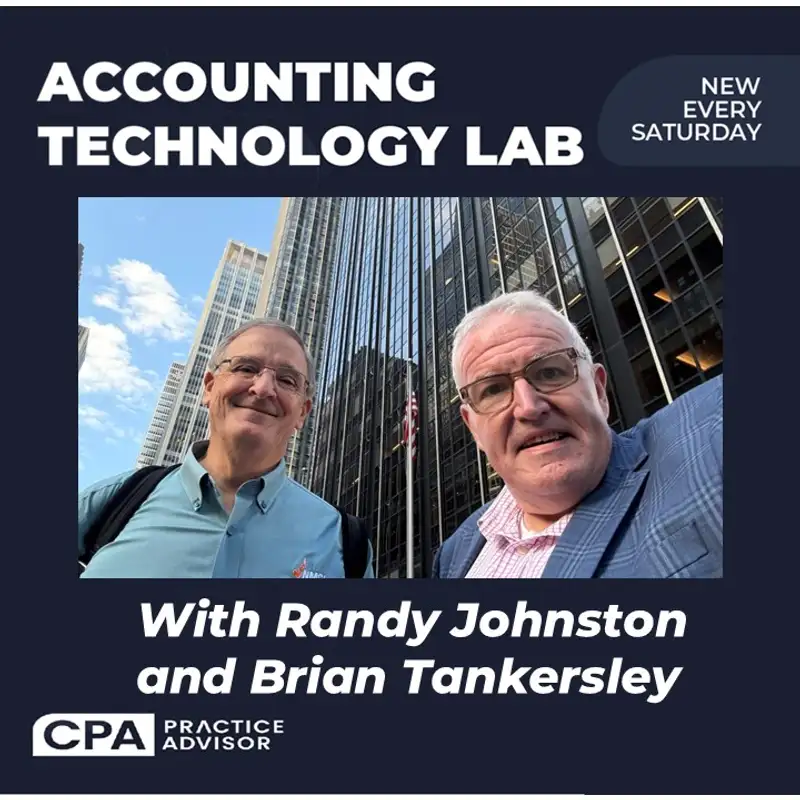
Hosts: Randy Johnston and Brian F. Tankersley, CPA.CITP, CGMA
Program: Accounting Technology Lab, presented by CPA Practice Advisor
Episode length: Approximately 10 minutes
Hosts: Randy Johnston and Brian F. Tankersley, CPA.CITP, CGMA
Program: Accounting Technology Lab, presented by CPA Practice Advisor
Episode length: Approximately 10 minutes
Episode Summary
In part two of the conversation with Puzzle co-founder and CEO Sasha Orloff, the Accounting Technology Lab examines how accounting professionals can begin adopting artificial intelligence without abandoning their existing knowledge, systems, or professional judgment.
Orloff recommends starting with a difficult but low-risk problem rather than using AI only for trivial experiments. Accountants should remove client-identifying information, use personal or anonymized data, and practice explaining a task as clearly as they would to a highly capable new employee who lacks accounting experience. A prompt, in this context, becomes much like a detailed checklist: it defines the expected steps, safeguards, and outcome.
The discussion also distinguishes helpful AI assistance from uncontrolled automation. Puzzle’s approach allows agents to prepare work while requiring human approval before anything is posted to the ledger. Randy Johnston emphasizes that the profession does not need technology that eliminates accountants; it needs technology that makes accountants more effective.
Orloff argues that firms creating a safe culture of experimentation will improve productivity, profitability, and client service. Brian Tankersley closes with a challenge to accounting leaders: become sufficiently familiar with AI to evaluate solutions intelligently, guide employees, and lead clients through change. The central message is simple—AI adoption does not require reckless transformation, but it does require action.
Orloff recommends starting with a difficult but low-risk problem rather than using AI only for trivial experiments. Accountants should remove client-identifying information, use personal or anonymized data, and practice explaining a task as clearly as they would to a highly capable new employee who lacks accounting experience. A prompt, in this context, becomes much like a detailed checklist: it defines the expected steps, safeguards, and outcome.
The discussion also distinguishes helpful AI assistance from uncontrolled automation. Puzzle’s approach allows agents to prepare work while requiring human approval before anything is posted to the ledger. Randy Johnston emphasizes that the profession does not need technology that eliminates accountants; it needs technology that makes accountants more effective.
Orloff argues that firms creating a safe culture of experimentation will improve productivity, profitability, and client service. Brian Tankersley closes with a challenge to accounting leaders: become sufficiently familiar with AI to evaluate solutions intelligently, guide employees, and lead clients through change. The central message is simple—AI adoption does not require reckless transformation, but it does require action.
Key Episode Themes
- Begin with meaningful work. Testing AI on an authentic, complicated problem reveals more than asking it to perform a novelty task.
- Use low-risk information. Remove client names, confidential information, personally identifiable information, and other sensitive data before experimenting.
- Treat prompts as process documentation. AI performs better when instructions describe each step, decision, constraint, and expected output.
- Keep accountants in control. AI can draft transactions, reconciliations, analyses, and journal entries, but accountable professionals should review and approve the results.
- Create a culture of experimentation. Firm leaders should give employees permission and guardrails to explore AI safely.
- Leadership requires firsthand knowledge. Accountants do not have to adopt every AI product, but they need enough experience to distinguish practical capabilities from marketing claims.
Suggested Episode Highlights
- Sasha Orloff explains why accountants should test AI on difficult, meaningful tasks.
- Detailed prompts function like checklists for accounting processes.
- Firms should experiment only with anonymized, nonconfidential information.
- Puzzle’s agents require approval before posting changes to the ledger.
- AI should enhance accountants rather than remove them from the process.
- Accountants retain responsibility for judgment, review, and accountability.
- Firm leaders must establish guardrails that make safe experimentation acceptable.
- Practical AI productivity in accounting is beginning to move beyond novelty.
- Professionals who learn now may gain improvements in margins, capacity, and service.
- Accounting leaders must develop enough firsthand knowledge to evaluate AI vendors critically.
- CPAFirm
- ClientAccountingServices
- CAS
- MonthEndClose
- ProfessionalJudgment
- ResponsibleAI
- HumanInTheLoop
- DigitalTransformation
- PracticeManagement
- PromptEngineering
- AccountingPodcast
- Puzzle
Products, Services, and Companies Mentioned
Product, service, or companyContext in the episodeXFacebookLinkedInInstagramPuzzle | AI-native accounting platform and ledger discussed by Sasha Orloff; supports agent-assisted workflows with approval controls | @puzzlefin | No official account identified | Puzzle | No official account identified
ChatGPT | General-purpose AI assistant suggested for testing anonymized transactions and charts of accounts | @OpenAI | OpenAI | OpenAI | @openai
OpenAI | Developer and publisher of ChatGPT | @OpenAI | OpenAI | OpenAI | @openai
Gemini | Google AI assistant suggested for controlled accounting experiments | @GoogleGemini | Google | Google | @googlegemini
Google | Developer and publisher of Gemini | @Google | Google | Google | @google
Claude | Anthropic AI assistant suggested for controlled accounting experiments | Anthropic | No official product-specific account identified | Anthropic | No official product-specific account identified
Anthropic | Developer and publisher of Claude | @AnthropicAI | No official account identified | Anthropic | No official account identified
X, formerly Twitter | Social platform referenced as a source of AI news and discussion | @X | Not applicable | X | @x
CPA Practice Advisor | Presenter and sponsor of the Accounting Technology Lab | @CPAPracAdvisor | CPA Practice Advisor | CPA Practice Advisor | @cpapracticeadvisor
ChatGPT | General-purpose AI assistant suggested for testing anonymized transactions and charts of accounts | @OpenAI | OpenAI | OpenAI | @openai
OpenAI | Developer and publisher of ChatGPT | @OpenAI | OpenAI | OpenAI | @openai
Gemini | Google AI assistant suggested for controlled accounting experiments | @GoogleGemini | Google | Google | @googlegemini
Google | Developer and publisher of Gemini | @Google | Google | Google | @google
Claude | Anthropic AI assistant suggested for controlled accounting experiments | Anthropic | No official product-specific account identified | Anthropic | No official product-specific account identified
Anthropic | Developer and publisher of Claude | @AnthropicAI | No official account identified | Anthropic | No official account identified
X, formerly Twitter | Social platform referenced as a source of AI news and discussion | @X | Not applicable | X | @x
CPA Practice Advisor | Presenter and sponsor of the Accounting Technology Lab | @CPAPracAdvisor | CPA Practice Advisor | CPA Practice Advisor | @cpapracticeadvisor
Verification note: Social-media availability and account names can change. Puzzle’s website links directly to its LinkedIn and X accounts.
Creators and Guests

Host
Brian F. Tankersley
Nationally recognized speaker (K2 Enterprises, 48 states in US + Canada) podcaster & author on accounting tech. I’m also a beekeeper, a husband, and a dad.

Host
Randy Johnston
Randy Johnston is a nationally recognized educator, consultant, and writer with over 40 years experience in Strategic Technology Planning, Systems and Network Integration, Accounting Software Selection, Business Development and Management, Disaster Recovery and Contingency Planning, and Process Engineering.